
A Voice in Flight
poem from open mic night

Scratches kept for years in paper sealed with soot
now play on the radio.
Jagged lines are preserved as art:
visual imprint of a voice,
reverberations riding time
to be observed by ears as well as eyes.
Besting Edison by twenty years,
and sixteen before Bell sends sound
along without a body, this forgotten
Scott de Martinville launches his daughter’s voice
like a medieval bird bearing a message,
flutter of white wings from a hopeful hand.
Her journey, a century and half of smoky flight,
ends when she finds us propelling voices
across oceans, time zones, and the dizzy
spaces between mountains to the ears of those
who easily believe they can receive
this myriad of missives.
Her ghostly girlish warble,
so recently transcribed from its blackened sheet,
echoes like a portent,
trying to touch me
as I search for meaning in this first oral record
of a human voice.


(first published in SNR Review, Summer 2009)
Composition Notes:
On Friday night, I joined three other Substackers at our local open mic night. What a joy to get to interact with writer friends in person. For my reading, I chose two poems inspired by news articles. The first poem I read, “A Voice in Flight,” describes the first record of a human voice.
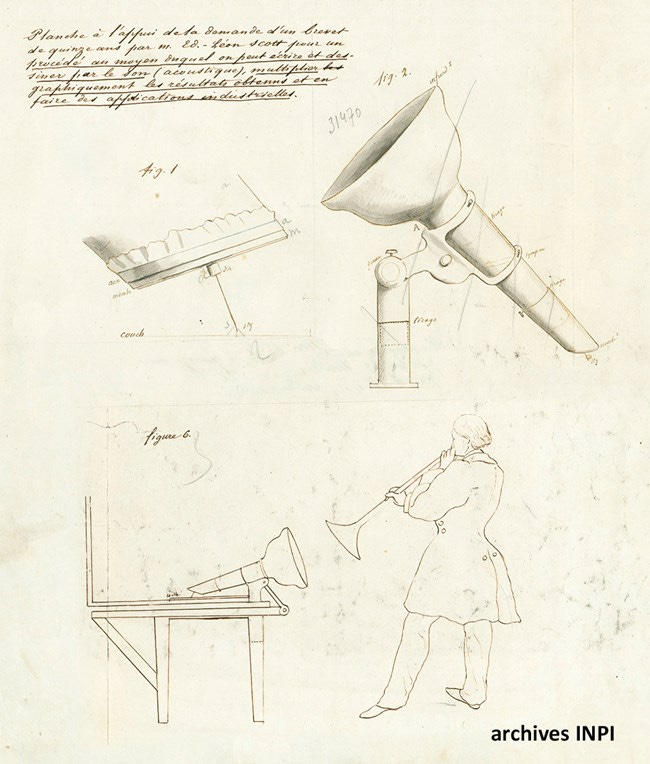
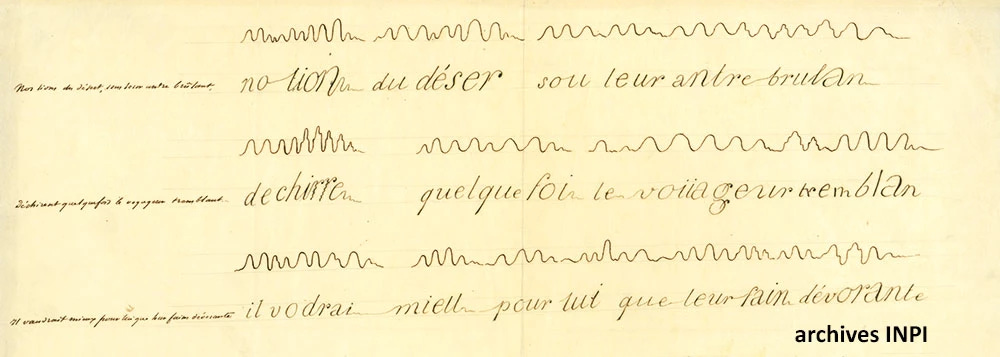
In 1860 Edouard-Léon Scott de Martinville invented a machine called the “phonautograph” that made sound recordings but couldn’t play them back.1 Think of his device as similar to a seismograph sensing and recording the vibrations of earthquakes.2 He thought that if the vocal vibrations were visualized, they could one day be interpreted the way people read sheet music. Scott de Martinville’s goal was simply to preserve and study the visual sound waves, and he had no concept of a playback element; however, in 2008 these recordings were made audible. You can listen to his recording at the Youtube link below.
When I initially wrote and published this poem, it was believed that the voice was Scott de Martinville’s young daughter singing at normal speed, but now researchers think it was actually the man himself singing slowly.3 This complication of deciphering who is singing adds layers to the poem that I was oblivious of while writing it. Communication is fraught with possibilities for misunderstanding, even when you don’t add in complications such as sooty sound waves that are over a hundred and fifty years old, but the fact that a communication cycle is ever successful is worth celebrating.
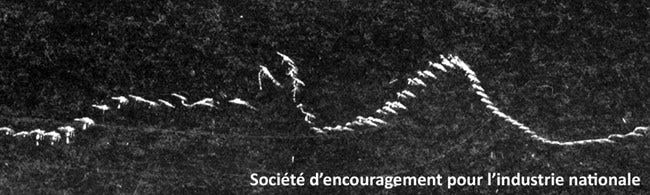
This historical machine mimics the membranes of your eardrum and contains a boar bristle stylus which moves in response to the resulting vibrations. Stop and consider the marvel of your own ears responding to external stimulus. Your brain is designed with the ability to convert sound waves into meaning-making units that become pictures and thoughts and emotions and logic and memory. Take a look at the images that the phonautogram produced and give thanks that your brain deciphers similar vibrations. Sound itself is a miracle. Your brain and body is the most complicated instrument in your home, without contest. At a conservative estimate, you have over 100 trillion connections between 86 billion neurons, providing you with computation abilities that outweigh supercomputers at the energy output of a lightbulb.4
The next time you talk on your phone, take a moment to consider the long-distance communication which is an accepted part of our everyday lives and which scientists dreamed of for centuries. Our reality is the result of their flights of fancy and the arduous toil of scientific discovery. Pause. Marvel. Then put your phone down and go to an open mic night with other local writers. Here’s to more in-person communication in the future!
I praise you, for I am fearfully and wonderfully made.
Wonderful are your works;
my soul knows it very well.
Psalm 139:14
Origins of Sound Recording: Edouard-Léon Scott de Martinville - Thomas Edison National Historical Park (U.S. National Park Service), https://www.nps.gov/edis/learn/historyculture/origins-of-sound-recording-edouard-leon-scott-de-martinville.htm.
First Recorded Sound: Scott, Edison and History of Invention | TIME, https://time.com/5084599/first-recorded-sound/.
Earliest Known Sound Recordings Revealed, https://www.usnews.com/science/articles/2009/06/01/earliest-known-sound-recordings-revealed.
Is the Brain Really Just a Biological Computer? | Psychology Today, https://www.psychologytoday.com/us/blog/consciousness-and-beyond/202506/is-the-brain-more-than-just-a-biological-computer?msockid=261b79de11816ede23a06b7810186f.
Well... that is fascinating, Abigail!
Also, a wonderful poem!
A delight to meet you at today's Zoom Call poetry reading.
Best Wishes - Dave and Meg :)
Such a delight to hear you read this poem in person, and now I am savoring it with a second (slower) reading a few weeks later. I love the revelatory ending.