
Hospitable Poetry #6
Kilby Austin on Emily Dickinson


If you are just joining this series, here is the link to the intro and the five previous posts by Renee Emerson, A. A. Kostas, Brit McReynolds, Mark Rico, and Esther Jane.
Kilby Austin’s poetry made its way into my commonplace book with her blank verse meditation on motherhood “This gentle magic.” It is one of those poems that gave me an out-of-body experience, when you recognize yourself so fully in another’s words you can feel compassion for your own person in a moment of transcendence. If you haven’t read it yet, her most popular poem “For my son, till we have faces” is one you don’t want to miss. I thoroughly enjoyed her joint poetry reading with Joffre Swait, and the fact that you can listen to it while cleaning your kitchen means you have the potential to transform a mundane chore in your future into a rich literary experience. Please subscribe to Kilby (and all the poets in this series) if you are looking for more poetry written by contemporary poets. Today’s poem by Emily Dickinson is a gem I had never encountered before, and Kilby’s lovely essay serves as a model in how to approach a poem and notice what it is saying until it opens up to you.
I look forward to hearing your thoughts in the comments!
Love, Abigail
Emily Dickinson Invites Us to Wonder
by Kilby Austin
An inscription in the spidery hand of my left-handed grandmother tells me that the coffee-table book The Mystery of Beauty: Poems by Emily Dickinson was a gift for my seventeenth birthday. Filled with beautiful nature photography to match the selection of poetry, the book has travelled with me across two decades and three continents since Nonnie gave it to me. I have read it all through, but not enough to be terribly familiar with it; while Dickinson is a good candidate for America’s greatest poet, she was never my favourite, and for most of the poems in this collection I feel no compulsion to linger or reread. However, the book falls open naturally to its last page.
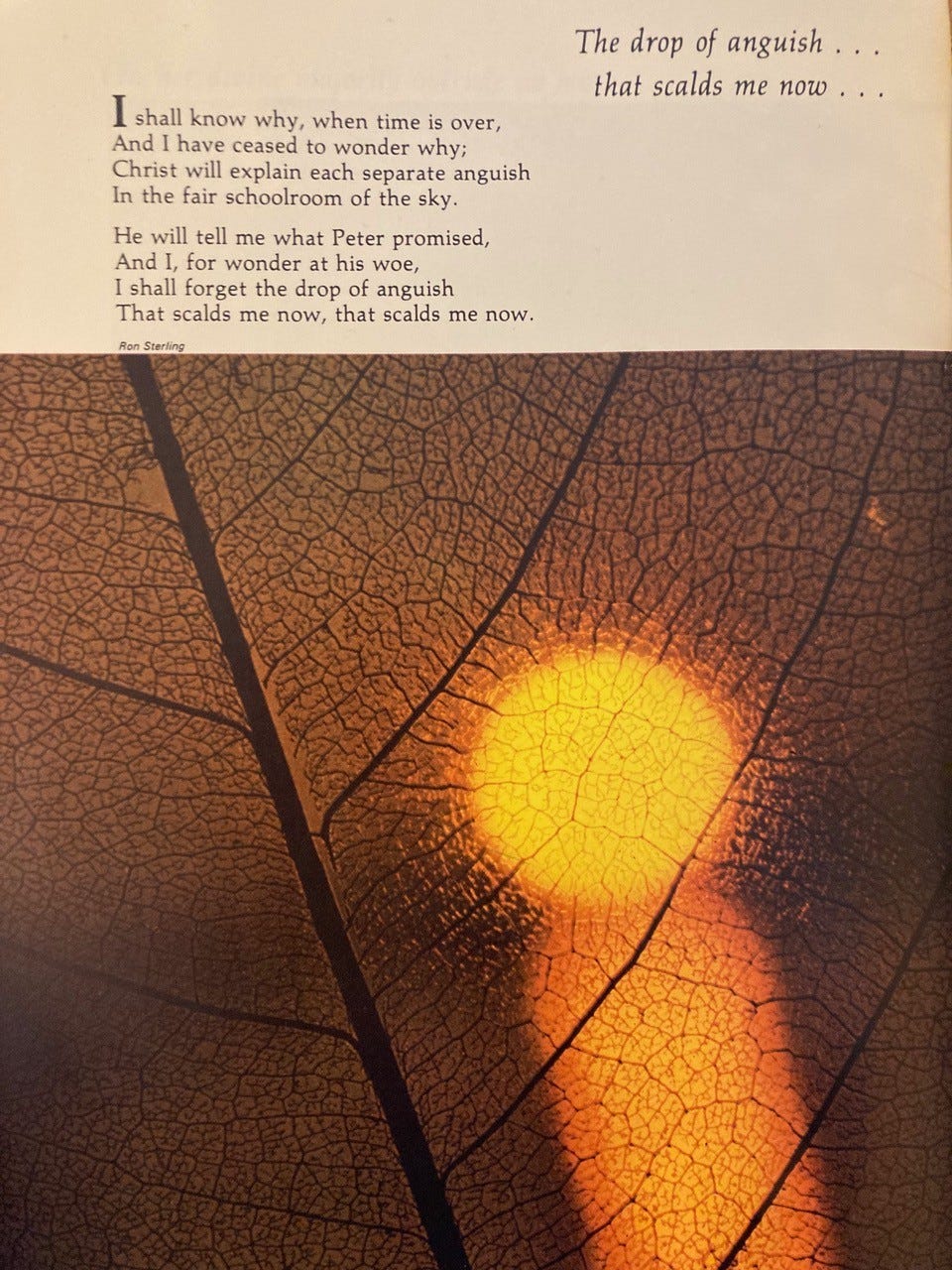
Here, above a photograph of (I think) the sun glimpsed through the dried veins of a leaf, a poem is printed that captivated me on its first reading. I have kept the book all these years mainly for this poem, and my grandmother’s inscription on the front flyleaf. Not that I have the need to reference it: without conscious effort on my part, I memorised it at some point early on. It has gone so deep into my soul that I have met it there whenever life has plunged me into the depths.
I shall know why, when time is over
by Emily DickinsonI shall know why, when time is over,
and I have ceased to wonder why;
Christ will explain each separate anguish
in the fair schoolroom of the sky.He will tell me what Peter promised,
and I, for wonder at his woe,
I shall forget the drop of anguish
that scalds me now, that scalds me now.
It is such a hospitable poem that it needs no formal introductions from me or anyone else. It flings open the door and waves you in like an old friend. Have you been here before? And yet every time you return, you seem to notice something new—but new like the trinket on grandmother’s mantel that was always so much part of the furniture that you didn’t properly notice it till just now.
So you don’t need careful analysis, you don’t need to know anything about poetry, you hardly need anything but basic English to enjoy this one. With but eight lines in two stanzas, it takes less than a minute to read. It asks so little of you but gives so much—especially the punch at the end that all great poetry delivers. When you get to that last line your breath catches a little, and you know you have to read the poem again.
Let’s suppose you come to it as a non-poet, as not even a regular reader of poetry. The first thing you will notice is how easy it is to read. Though written in a natural diction, there is a lilt that you might not know is called meter, but you enjoy its subtle regularity. You will soon notice the end-rhymes of the even-numbered lines, unforced and pleasing; they lodge the words in your mind so that prediction makes recall easier. You notice three characters: the first person, Christ, and Peter. Even if you don’t know the story of Peter’s denial of Christ at his trial, you can roughly fill in the blank Emily leaves where Peter promised and take the invitation to forget your own drop of anguish. And you will come to the last line that repeats, like a soft sob, and feel all the incredible gentleness in Christ’s explanation.
Then perhaps you will notice how Emily plays with tense. For the most part, the poem is written in the future: I shall know why…Christ will explain…he will tell me…I shall forget. But there are key moments that are present, not the least of which the ending; there is also the implied present of when I have ceased to wonder why—though there will come a time when I have ceased to wonder, that time has not come now. The whole poem is underwritten by the question why in the present, which circles back, like grief, in the ending.
You notice the repetitions. There is the shuddering final repetition in this brief poem, but there are others scattered here and there: why and anguish and, poignantly, wonder. Wonder’s repetition is poignant because in its first use it is speculative, questioning, while its second use shifts to reverence and amazement. That shift is key to the pendulum movement of the poem.
So you notice the emotional weight of the language now: the plaintive why in the opening, and the self-soothing promise that an answer is waiting in the fair schoolroom of the sky for each separate anguish. This is a child’s poem. Only a child’s heart can be both as self-consciously ignorant and as content in that ignorance as the poet’s voice here. The child is assured that all the pain of ignorance has only to be allayed by a good teacher at the right moment. Emily entrusts that role to Christ and moves from present anguish to future hope.
The only use of the past tense occurs embedded in the first line of the second stanza, where the poem turns: He will tell me what Peter promised, / and I, for wonder at his woe sounds a suddenly darker chord, one of mystery. The very words mimic the mystery: whose woe is it, precisely, that will make us forget ours? Is it Christ’s in being denied and abandoned at his moment of crisis, or is it Peter’s in being the denier? Which woe is greater, I wonder? Emily leaves it unclear, but either one will suffice: both are too great not to swallow all our anguish in the pathos of the passion story. And the past tense in that little three-word allusion, what Peter promised, tells us that even the greatest woe will one day be over, with time itself.
And there the poem resolves (almost). The promised answer in the sky’s fair schoolroom, it seems, may not be an answer, strictly speaking. When faith is replaced by sight, it will be the sight of Christ that explains each separate anguish with reference to his own—and the anguish of being apart from him that, for those in his fair schoolroom, will be forever past. Will it be that when we can ask God anything, we won’t want to anymore? Will we instead be “lost in wonder, love, and praise”1 at the vision of his scarred hands that bled for all our anguish as well as his own?
Still, Emily leaves us with no triumphalist hymnody this side of the sky, but rather immense tenderness: Christ identifying with us and the lowliness of our estate, so easily scalded as we are by drops of anguish. Though I shall know why, when time is over, perhaps there is still that one drop of anguish / that scalds me now. We only live now. And so the poem shifts again from future hope back to present anguish, but gently, patiently. There are no easy answers here. There is only waiting.
No poetic education is needed, no learning obscure references or words, to read this singular little poem. It offers itself on its own terms, and with it a moment of profound vision, a balm for wounds not to be healed lightly. Towering colossi of poetry can scarcely accomplish more and are certainly no match in economy. I imagine that it will be this sort of poetry, with its humble hospitality, that will last the longest. Or at least in the most hearts.
It is poetry’s power to be both particular and universal enough to act as an intimate friend to almost anybody. There is room enough between the lines to relate your own personal experiences, but not so much room that the poem itself is meaningless or inscrutable. Myself a less-than-expert reader, I love to read the deceptively simple poetry that makes room for the common man by inviting him into a deeper encounter with reality almost without his knowing it. Here, rather than being instructed on philosophical questions of the nature of time, we find ourselves playing time as a musical instrument to salve our suffering; rather than wrestling a straightforward, propositional answer to the problem of evil, we experience the answer within the music of the poem, for there is an unarguable goodness even in the minor key of the dal segno at the end of this brief, beautiful meditation. I shall forget the drop of anguish that scalds me now—that scalds me now.
Charles Wesley, “Love Divine, All Loves Excelling,” https://hymnary.org/text/love_divine_all_love_excelling_joy_of_he.
 | A guest post by
|
I loved this, Kilby! Emily Dickinson was one of the first poets I obsessed over when I was in middle school and high school. I've read so many over the years, but I never read this one! It is beautiful. I plan to commonplace it after leaving this comment.
Your explication was so gentle and friendly. You showed us elements of the poem in the same way one might handle and share about items in grandmother's hutch, or the traits of a wild bird which has come close and might fly away if we move too fast. Rather than "breaking down" the poem, you left it whole and pointed out traits and behaviors we might want to take note of, but always with an eye to the poem's well-being as a poem.
Thank you for this excellent essay.
Kilby, thank you for choosing this spacious poem. It's a beautiful example of compassionate restraint by the poet. You show us what makes it so powerful--how Emily leaves ample space for our own reflections and anguish. I can see Peter weeping "bitterly" though she only gestures ever so lightly toward him. And she waits until the final line to show her own "soft sob" as you so perfectly say it. Truly a tender, comforting poem. No wonder you have loved it all these years.