
Hospitable Poetry #3
Brit McReynolds on "Still, Citizen Sparrow" by Richard Wilbur


If you missed the intro, Prepare a Table explains the heart behind this series.
In our first post of the series, Renee Emerson took us through a moving poem by Heather Cadenhead. The following week, A. A. Kostas analyzed “Invictus” and “Crossing the Bar.”
Brit McReynolds writes beautiful poetry with equal parts lyricism, spiritual insight, and “scope for imagination” (as Anne Shirley would say). I have many favorites of hers, including “Here, on the first day of its birth,” which imagines the new year “trembling like a newborn foal.” I copied into my commonplace book her poem “Where the Wild Sage Grows” because the sense of hope it conveys to me is palpable and believable. In today’s essay, Brit invites us to consider a poem by Richard Wilbur with a surprising subject which turns conventional beauty norms upside down. I can’t wait to hear what you think!
Love, Abigail
Seeing Behind the Veil: Richard Wilbur’s “Still, Citizen Sparrow” and thoughts on charitable poetry
by Brit McReynolds
When Abigail asked if I would like to be a part of this series, I confess there was a bit of hesitation on my end. Personally, I feel a bit of a layman in the realm of academia. My education in poetry has come quite organically, and very much on my own. As such, I hardly consider myself among those worthy of the task. I am still new to this. My appreciation for poetry has only in the last few years evolved into the writing of my own and being brave enough to put my work out there. But, thinking along these lines, and taking all that into consideration, perhaps that alone gives me some qualification to speak on the subject. I am, in a sense, still more closely lumped in with the “common man.” There is still much that goes over my head when poems become all too self-referential, too exclusive that I can’t see the beauty in them. But beauty should be charitable, not miserly.
Among this series there will undoubtedly be plenty of reference to Steven Searcy’s essay on limiting poetry’s feedback loop. Abigail had some terrific thoughts and insight on the matter stating, “poetry is meant to feed our spirits, not our egos, and remind us of truth both portable and memorable, to serve as a light in the darkness.” Aptly put. What draws us to poetry? What about it speaks to us? These are questions I must ask myself.
Ultimately, the poems that draw me in have within themselves an ineffable quality. I am not so much concerned in the moment with the particulars of form, but rather being struck in my spirit, become aware that I have just received a deposit of some measure of truth and beauty, for better or worse. These types of poems take on a life of their own, grab us by the shoulders and shake us out of our stupor.
The issue with contemporary poetry is that it has widely become anemic. It lacks a richness in the blood. Dana Gioia touches on the reasons for this in his essay “Can Poetry Matter?”
“Poets have created enclaves in the academy almost entirely separate from their critical colleagues. They write less criticism than they did before entering the academy. Pressed to keep up with the plethora of new poetry, small magazines, professional journals, and anthologies, they are frequently also less well read in the literature of the past. Their peers in the English department generally read less contemporary poetry and more literary theory. In many departments writers and literary theorists are openly at war. Bringing the two groups under one roof has paradoxically made each more territorial. Isolated even within the university, the poet, whose true subject is the whole of human existence, has reluctantly become an educational specialist.”
Now, I may be overly critical in this, but this reflects our cultural shift toward rewarding participation over merit, as well as the urgency to produce. Poetry is less inspired and more manufactured these days. Everything is a rush to say something, anything, and to say it first. I fear we lack the reticence needed to write truly great poems. There was a time when critics were actually critical, and so a poem making it into the public sphere held real value. But poets and lovers of poetry have enclosed themselves into increasingly anemic circles, cloistered away in the monastery of academia, and sheltered away from where the rest of the world is busy living. This might do well to keep poetry “pure,” but it does very little good in relating to the world.
Poetry should speak to us. If it is to be hospitable at all, it must allow anyone who desires to find a seat at the table. The truly great poems offer more than an open chair and base fare though. They have depth. A first reading might delight anyone, but a second reading reveals more. One who is well versed in classic works or famous poems and poets might catch references others miss. Imagery can hold multiple meanings for the trained eye while still allowing something for the untrained eye to enjoy. But for me, all that is not as necessary as whether or not the poem awakens something in me, gives me a glimpse into a hidden world, helps me see beyond the veil.
One of my favorite poets, Richard Wilbur, does just this. I was introduced to his work only this last year by my friend J. Tullius, and Wilbur very quickly became a staple in my reading. I find myself meditating on his words, incorporating them into my devotional times, quieting myself as if I am sitting in the company of an old friend. What he does sublimely is enlighten the ordinary. Take, for example, one of my favorites of his, “Still, Citizen Sparrow.”
Still, Citizen Sparrow
by Richard Wilbur

Still, citizen sparrow, this vulture which you call
Unnatural, let him but lumber again to air
Over the rotten office, let him bear
The carrion ballast up, and at the tall

Tip of the sky lie cruising. Then you’ll see
That no more beautiful bird is in heaven’s height,
No wider more placid wings, no watchfuller flight;
He shoulders nature there, the frightfully free,

The naked-headed one. Pardon him, you
Who dart in the orchard aisles, for it is he
Devours death, mocks mutability,
Has heart to make an end, keeps nature new.

Thinking of Noah, childheart, try to forget
How for so many bedlam hours his saw
Soured the song of birds with its wheezy gnaw,
And the slam of his hammer all the day beset

The people’s ears. Forget that he could bear
To see the towns like coral under the keel,
And the fields so dismal deep. Try rather to feel
How high and weary it was, on the waters where

He rocked his only world, and everyone’s.
Forgive the hero, you who would have died
Gladly with all you knew; he rode that tide
To Ararat; all men are Noah’s sons.
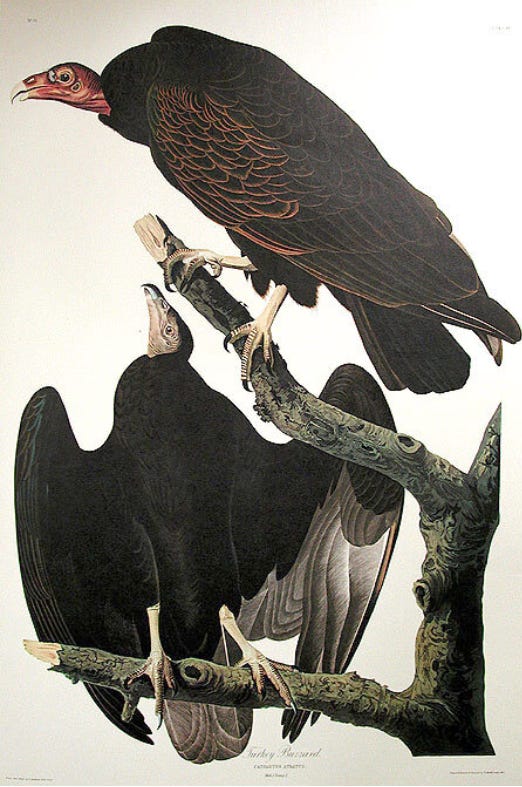
The first time I read this poem I sat in silence with it for a good while. Vultures, those haggard carrion birds, get a bad rap, usually associated with death and decay. And justly so, yet Wilbur does something wonderful here by taking that reputation and turning it on its head. He elevates it to a stately place among all birds, stating “Then you’ll see/That no more beautiful bird is in heaven’s height.” How like Christ to redeem the unlovable. Wilbur carries us from this imagery of the vulture to the story of Noah, likening him to inhabiting the same office as this misunderstood bird. Anyone not familiar with the story might miss the imagery here, but the story is widely known enough to remain accessible to most.
I read this and see Christ. I see his face underlying the words, the story of the redemption of mankind woven through, and the weight of such a charge. So misunderstood, so unloved, and yet these are those God loves, who offer themselves up to the ugly business of devouring death. It is a necessary office, but one I should think most would not choose of their own accord, and yet here we have those who do pointing us to the one who fulfills it supremely, to the uttermost.
What the poem does for me is peel back the curtain. The ordinary and common is transformed in my mind to what is really there, beyond what my eyes can see. And imagination is vital to the process. Of such Shakespeare writes in A Midsummer Night’s Dream.
The poet’s eye, in fine frenzy rolling,
Doth glance from heaven to earth, from earth to heaven;
And as imagination bodies forth
The forms of things unknown, the poet’s pen
Turns them to shapes, and gives to airy nothing
A local habitation and a name.
Such tricks hath strong imagination,
That if it would but apprehend some joy,
It comprehends some bringer of that joy
The essential function of the poet must be to see what others cannot and provide for them the lens through which the invisible becomes visible. We must “body forth”—give substance to—those “things unknown,” the “airy nothing” which the poet knows is actually something. It’s almost a shame to share only one of Wilbur’s poems with you all, because he does this so well.
“Society suffers by losing the imagination and vitality that poets brought to public culture,” Gioia says. If we strive for anything as poets, let it be to bring something worthwhile to the table. Beauty for the eye, music for the ear, and food for the soul.
 | A guest post by
|
I loved this so much. Vultures are such interesting creatures. I studied them a while back and was surprised by how structured their social systems are. Many species mate for life, much like eagles, and they operate within surprisingly ordered communal hierarchies. There is fidelity and intelligence there that we rarely associate with them.
So I agree with you. The vulture is not grotesque. It is faithful to its role. It occupies a necessary office in creation, high in heaven’s height yet deeply connected to the work below. I love the way you connected that faithfulness into something redemptive, something Christ-shaped, feels exactly like the charitable vision you describe.
I just subscribed. This is the kind of poetry I miss and find lacking in today's disembodied poetry. I've been banging my head about how the kind of poetry I find that gets published in literary journals lack sonic texture, a sonic haptic feedback from the way words are voiced by the lips, jaws and tongue, a recognition that words have beat and tempo and a willingness to use these to embody the poem's meaning. This poem has that. And for that I thank you.