
Hospitable Poetry #10
Rosa Lia Gilbert on Rhina P. Espaillat


If you are new to our series, here is the link to find the intro on hospitable poetry and the previous posts by Renee Emerson, A. A. Kostas, Brit McReynolds, Mark Rico, Esther Jane, Kilby Austin, Zane Paxton, Robert Charboneau, and Nick Chapman-Jones.
Today we hear from the poet who wrote one of the first poetry books I read in 2026. Rosa Lía Gilbert released her debut collection Under the Samán Tree in 2025, and I read it this January when I most needed her vibrant imagery to warm up my barren yard. As I read Rosa’s words, I was reminded of the exact poem that she brings to the table today. What is remarkable is that Rosa found Espaillat’s poem after she had written her collection, which so beautifully echoes and answers the ache in this poem. This desire for home and a place to belong is something Rosa explores at length. Although I have lived in the United States all my life, lines from Rosa’s poetry give voice to my own “longing / for an eternal place.” I encourage you to buy her collection (or ask your library to purchase it) so you can bask in her gorgeous words and tropical imagery infused with eternal hope. I can’t wait to hear from you in the comments!
Summer 2024
Burst of Life. The title for the Vessels of Light themed submission call stood still across my laptop screen. I felt partially numb inside from the last couple of years filled with putting parts of myself to death, hiding them, or otherwise ignoring them. But before I could stop myself, I read those three words—burst of life—and images began resurrecting in the graveyard of my mind.
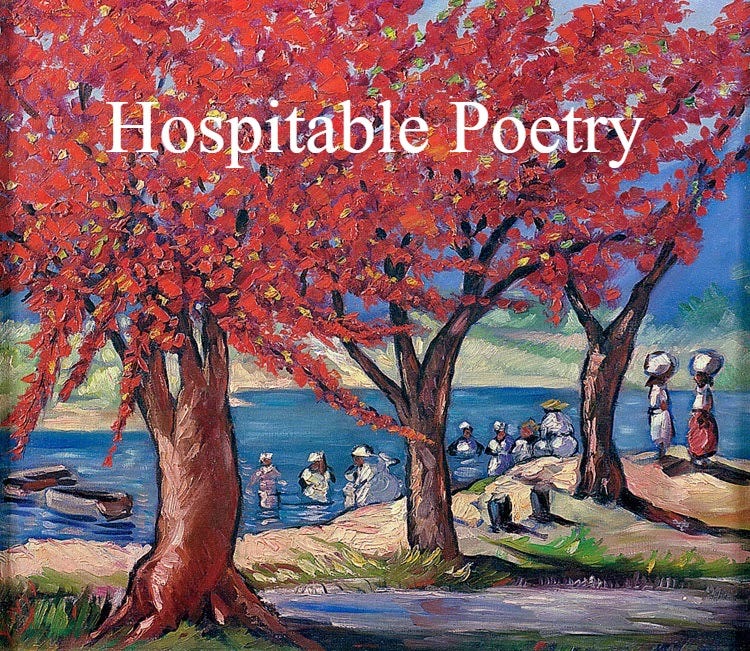
Flamboyanes, palm trees, Caribbean waters dipping into the horizon.
The land bursting with life was my own. The words threatening to spill over the seams of my heart were all in Spanish/español. But I was curled up on my queen-sized bed in suburban Ohio, the realities of that other life/otra vida seemingly so out of reach. I had somehow managed to convince myself that their relevance had reached an expiration date. And yet, in that moment, while my husband studied for his exam beside me and my three-year-old slept in her room, I allowed myself to dream again.
I gave my words permission to fly back home. To find the life/vida they had been missing.
****
Present Day
Poetry has the power to make us whole or to let us come back wholly to ourselves if we let it. It invites us to stand before the page and extends a hospitable embrace to any and all who would linger long enough with her. Both for the reader and the poet, poetry becomes a sort of sacred ground where one can piece truth, goodness, and beauty back together, wherever it can be found.
Do you want to process that loss? There’s a poem for that. Do you need to understand how things change and seasons come and go? There’s a poem for that. Are you longing for the beauty of the natural world, for ways in which it reveals to us the pillars of existence? There’s a poem for that.
But poetry is hospitable in a two-fold way.
Is there not a poem for that? And by that, I mean whatever it is you’re going through, whatever images you can’t tuck away neatly, whatever experiences keep nagging at your spirit. If there isn’t a poem for that, then poetry is the friend that says, “Come. Sit. Write.”
Poetry was and is a constant practice in returning home: of searching for the missing pieces of myself in words of my own, and of finding bits of myself wrapped up in the words of others. Rhina P. Espaillat is one such poet for me, whose words have felt like my own in many ways, laden with thoughts and experiences that offer a hospitable stay, or even a homecoming. Not only do we have a shared heritage—we are both from the Dominican Republic—but we share a sort of current coexistence. The reality of oscillating, constantly, between a heart language and a learned one, until both become welded together; one as much a part of you as the other. In her poem Bilingual/Bilingüe, I make myself right at home.
****
Bilingual/Bilingüe
by Rhina P. Espaillat
My father liked them separate, one there,
one here (allá y aquí), as if aware
that words might cut in two his daughter’s heart
(el corazón) and lock the alien part
to what he was—his memory, his name
(su nombre)—with a key he could not claim.
“English outside this door, Spanish inside,”
he said, “y basta.” But who can divide
the world, the word (mundo y palabra) from
any child? I knew how to be dumb
and stubborn (testaruda); late, in bed,
I hoarded secret syllables I read
until my tongue (mi lengua) learned to run
where his stumbled. And still the heart was one.
I like to think he knew that, even when,
proud (orgulloso) of his daughter’s pen,
he stood outside mis versos, half in fear
of words he loved but wanted not to hear.
****
You don’t have to be bilingual/bilingüe to get at the heart behind this poem. First of all, I love, as much as it pains me, the mention of her father in this piece. I think it’s a universal experience, that of feeling/being misunderstood by one’s parents. Whether it is a generational divide, opposing views, or simply a lack of empathy, it is common to feel, as Rhina describes, that our parents or family members want to keep us “separate.” Maybe for you this has nothing to do with language, but instead with ideas, beliefs, even traditions. Maybe you feel as though the image of you that others have formed in their minds versus the real you must be compartmentalized, but Rhina’s words call us back to wholeness.
“But who can divide the world, the word (mundo y palabra) from any child?” These lines always make me gasp a little. For the part of myself that is a bilingual woman—existing in a world that seems to want to cut me open, divide me, spread me out evenly, at all times. But, also for that other part that is a mother, raising a bilingual daughter, fear in my heart like in Rhina’s father, that a part of me will be forgotten, or worse yet, rejected by her. I think this is where we can take heed from this poem, both as individuals and as parents (for us who have children), to extend to others the kind of hospitality we’d want extended to ourselves, and the kind that this poem extends to its readers.
Let us not live life “half in fear” of who we are/could be, but instead as wholly ourselves. Whatever parts of yourself you have come to believe cannot coexist, this poem serves to dispel that belief by reminding us that “still the heart was one.” A first-language Spanish speaker can also learn to live, and thrive, and be in English. A mother or father can also be an artist. A Christian can also be a poet. A believer can also be, at times, a doubter.
Poetry is the house in which we can always stop for coffee/café. Here, questions unanswered are welcome, doubts can be processed, ideas can be shaped and reshaped, and both the reader of poetry and the writer of it can arrive as one and leave as the other. If you let it, poetry will help bring you home/a casa.
 | A guest post by
|
Thank you for sharing this insight, Rosa! John Keats would call the poet's capacity for and expression of the tensions you describe "negative capability". It is my favourite attribute of poetry. ♥️
I love this reflection! Rhina Espaillat is one of my favorite poets and I have loved this poem ever since I first read it, though I am not bilingual. I did grow up in Texas where Spanish is somehow always on the edge of hearing and have many friends who are bilingual.
I like how you elucidate that it's also a poem about parents and children, about longing for acceptance and fear of rejection, about trying to harmonize part of ourselves that feel irreconcilable, about feeling divided. About the heart's longing to be understood.