
From the Pigs
poem

We eat on hillsides by the graves;
“Gerasenes” they call it who come with chains
For the one who mangles his own flesh
On sticks and stones, screaming for death.

Move up we then along the sloping green
Side of the steep place where the peace
Allows our stomaches to find acorns’ smell
Hiding softly in moist tender soil.

Once the naked man with patterns streaming
Red across his back and chest
Frightened a lamb from his mother’s
Careless, lowered head into our midst,

Where we herded to our teeming center
Its young bleatings lost in snorts for meat,
Knocked it to the earth with long snouts eager
For tender trampled flesh, still moving feet.

Near the tombs the mushrooms grow rich
Tops out of loamy earth fed from
Bodies packed together underneath.
We move as one to sniff damp fungus sinews

Coming from the freshest standing tomb.
The mangled man jumps over our heads screaming
Towards the group who listens to their teacher.
"What do you want with me?"

His voice shrieks in concert with itself
As though the wind has ripped a thousand holes
Through his vocal cords and carried
Despair from countless souls into his throat.

They turn but wait in silence for their teacher
Who stands with arms spread wide as though
To gather this scarred man into his fold
Or to command him with a ruler’s reach.

"We are legion!" calls the wind from the dark
Abyss within this man. Their begging voices
Seem to bend away from the outstretched one
Standing like a reed upon the hill.

He bends to lift the creature, stiff with fear,
The first to touch him that we’ve ever seen, and looks
Into those lifeless eyes and sends light, palpable
And powerful, into the seething pools: "Go."

Our bodies stiffen with dark fear
And suddenly we hate the light, even the
Grayest clouds won’t cover us,
We move as one in panic for the deepest

Darkest crevice we can find.
Straight off the mountain, sweet relief
Will come as soon as our bodies
Hit the bottom of the cliff away from light.

first published in Utmost Christian Writers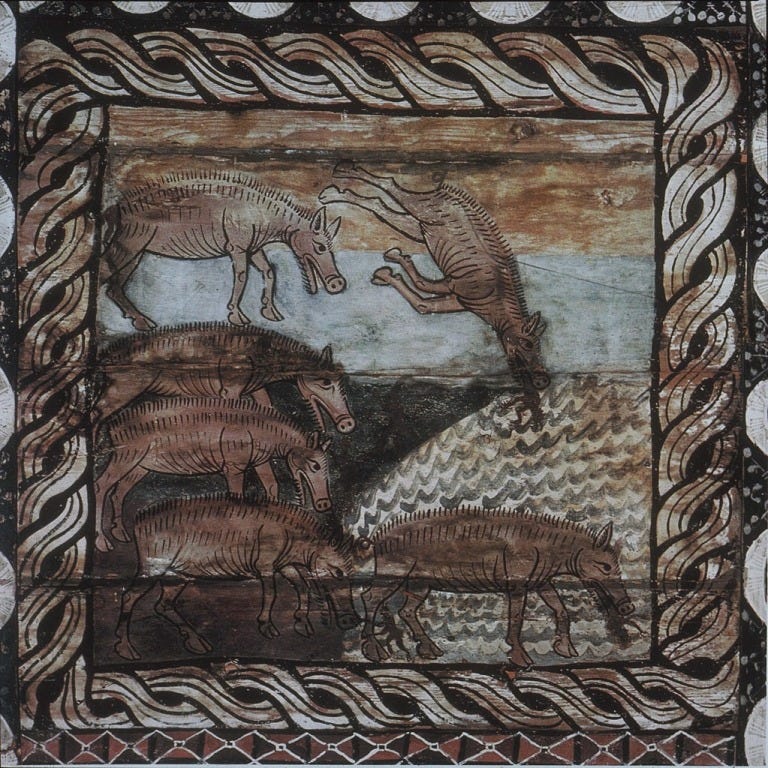
Composition Notes:
On Wednesdays, a group of writers share their poems as part of the Wednesday Poetry Club. Thank you, Tanner Olson, for inviting poets to join you in this project. The community and collaboration here is what makes Substack so special, and I am excited to join other poets in sharing poems in the middle of our week.
Poetry excels at making the familiar unfamiliar again. Considering the deliverance of the demon-oppressed man in Mark 5 from the perspective of the pigs allows readers who already know the story to sneak past any bored assurance that they have been here before. May we experience the liberty Christ offers the oppressed man as our inheritance today. By writing from a specific voice in the story, my imagination can access the sensory details and the message of redemption in a powerful way. This is one reason why the Psalmist tell us to “Sing to the Lord a new song” (Psalm 96:1). In reading and writing, we wrestle with the truth so it can change us.
The group of pigs as a collective voice gives a unique angle to the syntax and imagery. Some of these sentences lumber and shuffle the way I imagine the pigs rooting around with their snouts to the ground: “Move up we then along the sloping green / Side of the steep place . . .” I enjoyed playing around with the stilted wording and somewhat drunken cadence, like a waltz that can’t find its footing.
I imagine the pigs attacking a lonely lamb that wandered too far from its mother and had to research to see if this was in fact accurate. It turns out that as omnivores, pigs can eat meat, but they aren’t supposed to consume raw meat. I found veterinarian reports on what to do if swine ingested raw meat, and I also found reports of wild boars attacking an animal and eating it raw. This process of writing is not a tame and methodical distribution of facts. Very rarely do I research a phenomenon first and then write a poem. Instead, I follow the image that presents itself and see where it leads, and then after the poem is written, I go back and fact-check. The images string themselves along like beads on a necklace, like breadcrumbs through a forest, like clues on a treasure hunt, and by following the pictures you arrive at the poem.
If you know of more poems based on Mark 5, either ones you have read or written, I would love to see them. Please link in the comments. Keep singing new songs to the Lamb who entered our midst and gave his life so that we might walk in freedom. “It is for freedom that Christ has set us free” (Galatians 5:1), but when I hear the words too many times in the exact same order, I start to treat this freedom like an abstract assent to an idea and not freedom as a reality in my mundane life. Freedom to think rightly about myself and others. Freedom to access the joy of the Lord as my strength, especially when I am weary. Freedom to know the love of God not as a distant spiritual truth but a daily deliverance from anxiety. Freedom to obey Christ instead of my impulses. Freedom to believe truth. Freedom to think about others instead of myself. Freedom to breathe deeply of the earth’s sweetness after a rain. Freedom to lift my face to the sun. Freedom to lie down in peace and sleep. May his freedom be yours today. Thank you for being here.
My friend Kate Bluett wrote a Gerasene poem a few years ago, not on her Substack page yet, but on her blog page. It really stuck with me, though:
https://katebluett.home.blog/2021/01/29/gerasene/
I like the strategy of writing from the pigs' perspective.
This stanza especially stands out for me:
"His voice shrieks in concert with itself
As though the wind has ripped a thousand holes
Through his vocal cords and carried
Despair from countless souls into his throat."
What a powerful image!